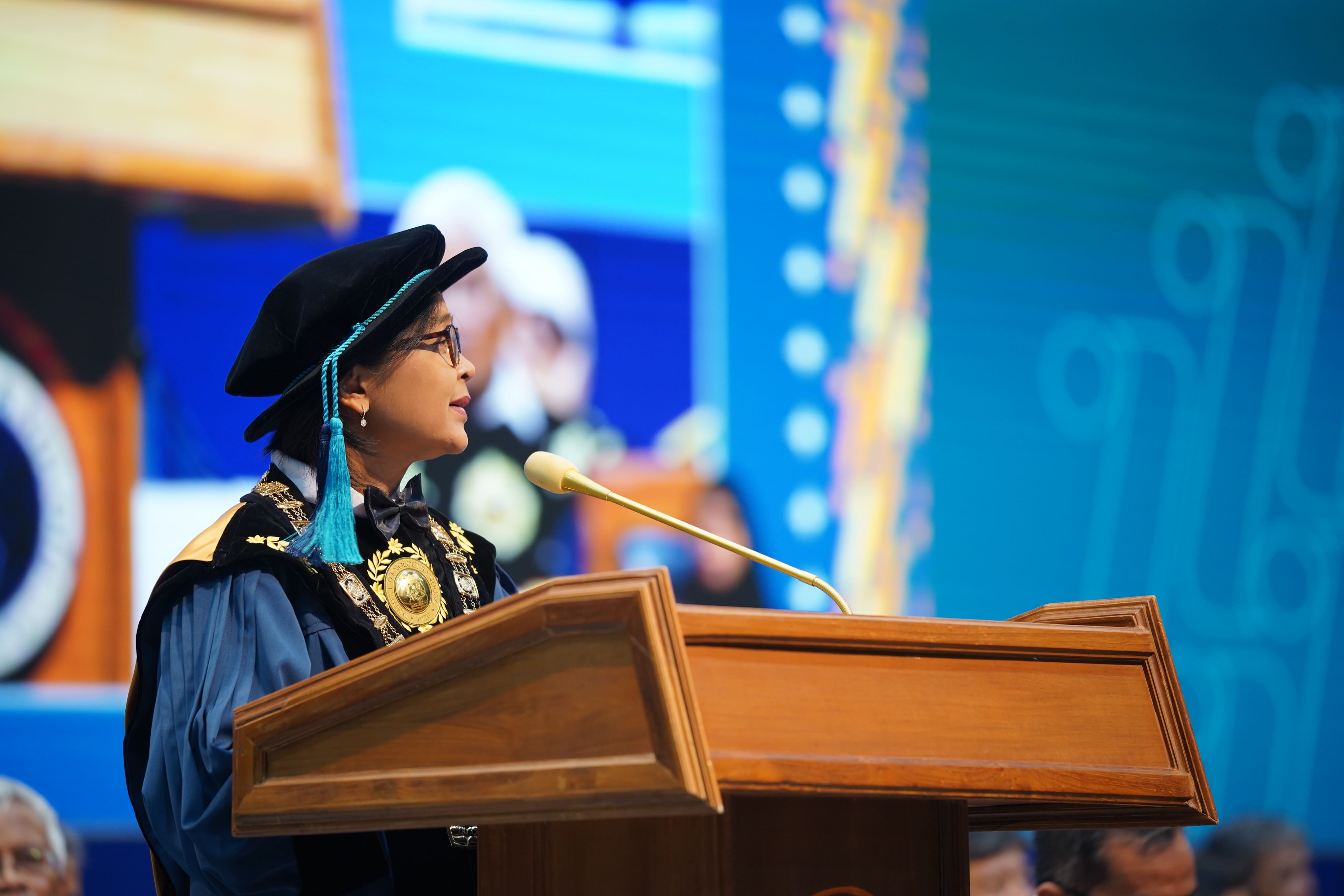
SPEECH BY THE RECTOR OF ITB
ITB'S SECOND GRADUATION FOR THE 2022/2023 ACADEMIC YEAR
“Contributing with Knowledge Exchange”
The honorable,
Chairman and Members of the Board of Trustees,
Chairman and Members of the Academic Senate,
Leaders and Members of the Professors Forum,
All Lecturers and Education Personnel,
Graduates
Assalamualaikum warahmatullahi wabarakatuh,
Greetings to all of us.
By expressing gratitude and praise to the presence of Allah SWT and accompanied by a sense of pride, I extend my congratulations to all graduates of the Doctoral Program, Masters Program, Bachelor Program, and Professional Program of the second graduation ceremony of Institut Teknologi Bandung for the 2022/2023 Academic Year.
On this day, you get a new degree from ITB, as a form of recognition of the competencies you have succeeded in achieving. By holding the new title, you are now carrying out a new responsibility that is higher than before, to be able to take part and contribute to the people and our country.
I believe that undergoing and completing academic studies in a crisis situation due to the Covid-19 pandemic poses its own challenges. Challenges that are not easy to face. But with your hard work, fortitude and patience, and the moral support and prayers of all your family and relatives, you have successfully faced the challenge.
For this reason, let us both offer praise and gratitude to Allah, God Almighty, for protection, and the overflow of His mercy and gifts to all of us.
To my beloved graduates,
Moving forward, you will enter a new career phase, whether in government institutions, private companies, non-governmental organizations, research or higher education institutions, international organizations or as entrepreneurs. As you embark on this new journey in your career, the key phrase is 'contributing'. The competencies you have gained while studying at ITB are certainly the primary capital to be able to contribute. However, there are several things to remember to succeed in your career journey.
We all believe in the vital role of science in driving change and achieving progress. Today, with the increasingly intense relationships between individuals/organizations in various fields and the widespread use of digital technology, the circulation of knowledge has occurred rapidly and reached multiple parties. Knowledge now grows and develops everywhere, in large, medium, and small companies, in government and non-governmental organizations, as well as in civil society groups and netizens. Such developments create new opportunities as well as new challenges. In such situations, 'knowledge exchange' is critical in creating added value or solving problems.
Knowledge is growing and developing everywhere, in specific situations such as on campus, research institutions, private companies, government organizations, communities, and social media. However, knowledge cannot yet become an agent of change in isolated conditions. In order to promote added value or solve problems, knowledge exchange is needed among individuals within and among organizations. Though our knowledge and academic competencies are essential assets, creating added value requires continuous social interaction and knowledge exchange.
In creating added value or problem-solving, knowledge exchange needs to be directed towards exploring the needs of our partners and connecting those needs with our competence. This step involves a process of exploration because "needs" are not already precise and can be discovered through a "question-and-answer" mechanism. Understanding needs and formulating problems requires exploration and learning through dialogues. Often times, this involves diverse perspectives. Finding solutions to the needs/problems of partners cannot be done by simply mapping one need/problem to one type of knowledge/competence. Real-world needs/problems do not recognize disciplinary boundaries. Therefore, real-world needs/problems must be explored and understood through interdisciplinary and cross-expertise approaches, and solutions require various competencies to be integrated. In other words, identifying needs/concerns and finding solutions needs to be done through systematic and collaborative knowledge exchange.
Knowledge exchange is different from information exchange. Knowledge exchange is consultative and involves social interaction and communication based on openness and mutual trust. Mainly, It is a human and cultural process rather than just a formal and mechanical one. The partners you encounter in your work environment come from diverse cultural backgrounds with their perspectives, values, traditions, and goals. There is diversity and differences to be respected and understood. It is also important to realize that our values, customs, and standpoints may differ from our partners. Therefore, knowledge exchange requires soft skills, which are the ability to interact, communicate, and collaborate humanly and culturally. To contribute to your future work environment, it is essential for you to continuously engage in interaction and knowledge exchange and collaborate in addressing needs/problems. If you pursue this with a solid intention to contribute, your soft skills will develop and strengthen.
Dear graduates I am proud of,
Ladies and Gentlemen,
ITB, through the Office of the Vice-Rector for Research and Innovation, is implementing the Excellent Scientific Culture Strengthening program. The program is designed and implemented with some considerations: i) research and scientific culture are essential characteristics of a knowledge institution, which in turn determine the capacity, capability, and function of higher education institutions; ii) research is the "intellectual life blood" that determines the progress and updating of knowledge, and becomes the foundation for innovation that supports the creation of added value in society.
Scientific culture is also essential as a foundation for knowledge exchange inside and outside campus. In a society with a scientific culture, all community members are involved in multiple forms of interaction, knowledge exchange, and collaboration to create added value or address issues. It is done with an attitude that upholds honesty, openness, equality, and joint progress/excellence. In addition, with a scientific culture, society can explore opportunities that arise through digital connectivity. A Digital Transformation will achieve tremendous success if it is supported by efforts to strengthen the scientific culture in various elements of society.
In closing, once again, I congratulate all graduates on your success. Allow me to express my gratitude to the parents who have entrusted their sons and daughters to us to pursue their education at ITB. I hope you can continue to create, maintain, and disseminate scientific culture—as 'scientific culture ambassadors of ITB', engage in interactions and knowledge exchange in various work environments, and consistently increase your spirit of leadership and solidarity to provide fundamental contributions to Indonesia. Your achievement is ITB's achievement, and ITB's achievement is yours—in harmonia progressio.
May God Almighty bestow His Mercy and Gifts on us and our nation, so that we can jointly realize economic recovery, and achieve a better life together. Aamiin.
Wassalamualaikum warahmatullahi wabarakatuh.
Bandung, April 8th, 2023
Prof. Reini Wirahadikusumah, Ph.D.
Rector of Institut Teknologi Bandung